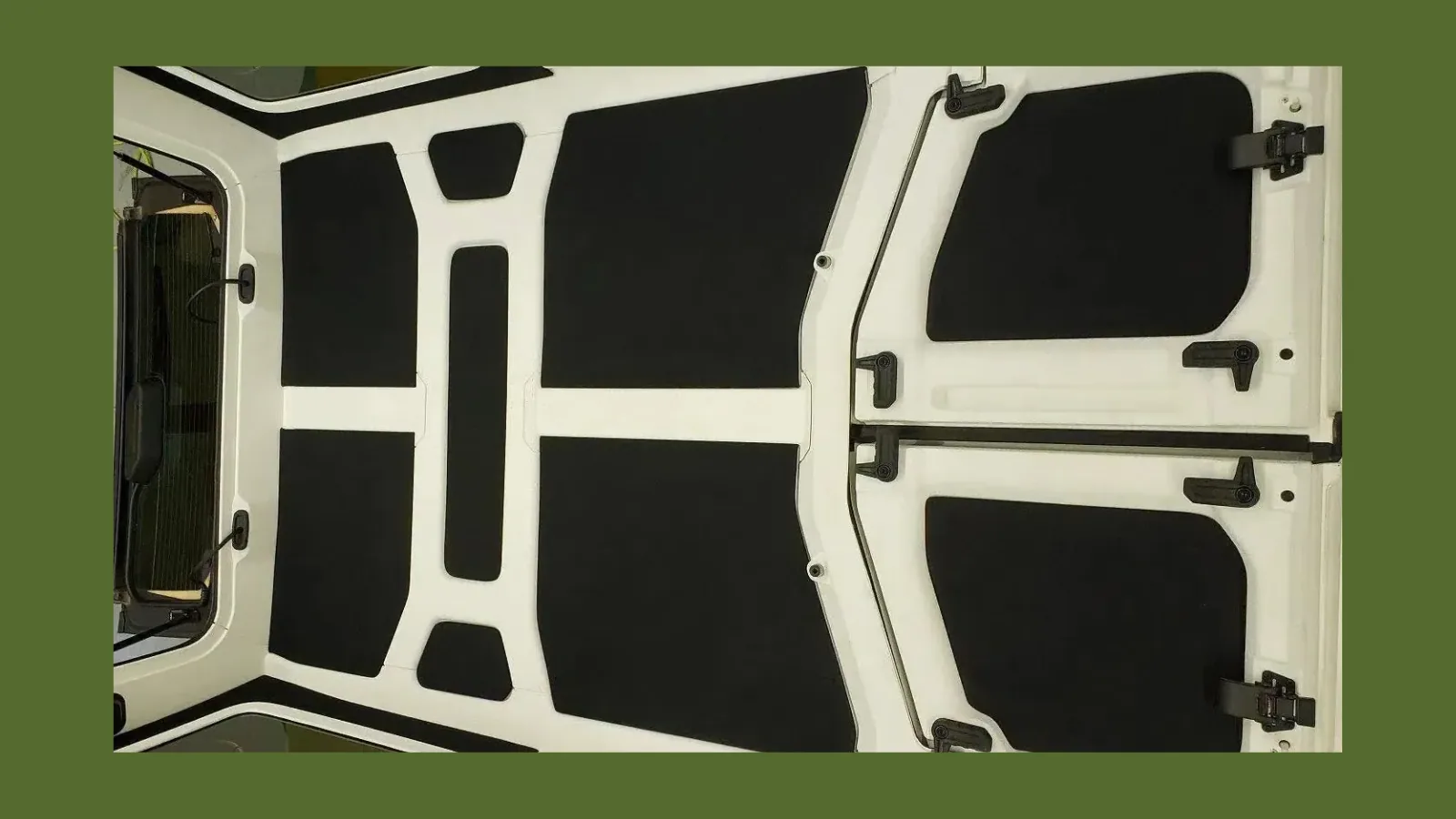
Floor, firewall, and wheel wells first. Doors second. Headliner is last.
I count on three certainties in this life: death, taxes, and road noise competing with every song I play at 65+ mph in my Wrangler JL. The forums will debate forever whether Jeep JL sound deadening makes a real difference—does it actually reduce the Jeep JL road noise problem? The answer is yes, though how much depends on which zones you treat, in what order, and with what products.
Skip a zone and you’ll think you wasted your time and money. Work through all five in sequence and the Jeep Wrangler JL that felt loud at 65 mph becomes something you’re genuinely comfortable driving every day.
- What’s Making the Noise: Five acoustically distinct zones divided across three logical teardown sessions. Each handles a different type of noise—whether structural panel vibration or airborne wind pressure—and requires a specific material fix.
- The Right Build Order: Grouped strictly by teardown efficiency. Session 1 tackles the Floor Pan, Lower Firewall, and Rear Wheel Wells while the seats and carpet are completely pulled. Session 2 focuses on the Door Assemblies. Session 3 finishes overhead with the Headliner.
- What to Buy: Kilmat 80 Mil, Noico 80 Mil, Hothead Sound Assassin, a dedicated closed-cell foam decoupled liner (like Noico Red 150 Mil or Siless Liner 157 Mil), dense rubber door seals, and a Hothead Headliner kit. The right one depends on your zone, your top, and your build.
- Soft Top Owners: A fundamentally different acoustic problem. While floor insulation cuts structural road rumble, a soft top fabric canopy is porous to airborne wind buffeting; a dedicated absorbing liner controls interior echo and thermal transfer rather than blocking outside noise completely.
Why the Jeep JL Is Loud at Highway Speed
The JL’s noise problem comes from five acoustically distinct zones. Treating them as one problem, or out of order, is why so many owners are disappointed with the results.
Teardown Session 1: The Bare Interior Tub
Zone 1 — Floor Pan: The largest metal surface in the cabin. Road vibration transfers through it as a constant low-frequency rumble. This is structural noise—it travels through metal, not air—which is why heavy butyl damping mats work here by altering the metal’s resonant frequency.
Zone 2 — Lower Firewall: Engine mechanical noise bleeds through the firewall into the cabin. It’s often more noticeable on the 2.0L 4-cylinder turbo than on the 3.6L V6. The lower firewall is exposed during the same teardown as the floor, making it highly efficient to treat simultaneously.
Zone 3 — Rear Wheel Wells: Tire contact road noise enters directly through the wheel well arches at highway speed. Butyl mats handle the structural metal resonance, but eliminating true airborne tire roar requires adding a decoupled acoustic foam layer—such as Noico Red 150 Mil or Siless Liner 157 Mil—on top of the mat.
Teardown Session 2: The Door Assemblies
Zone 4 — Inner Door Skins & Weatherstripping: The biggest acoustic gap in the vertical cabin. While the floor handles structural road rumble, the doors handle airborne noise and high-velocity wind pressure. Adding structural mass inside the door frame and sealing perimeter gaps separates a properly isolated cabin from one that simply has heavy floor mats.
Teardown Session 3: Overhead Insulation
Zone 5 — Hardtop Headliner / Soft Top Skyliner: At highway speed, wind buffets the fiberglass hardtop panels, causing them to resonate and amplify Jeep Wrangler wind noise like a drum overhead. The Hothead JL 4-Door Hard Top Headliner Kit damps the fiberglass sections and adds a multi-layer insulating barrier. Hothead’s testing confirms a 3–6 dB noise reduction and 35°F+ surface contact temperature reduction.
Treat one zone and you’ll notice partial improvement. Work through all five in order and Jeep JL sound deadening delivers what the forums argue about: a cabin that’s genuinely comfortable at highway speed.
The Chronological Build Plan for Jeep JL Sound Deadening
The sequence isn’t arbitrary. Grouping zones by their physical teardown requirements saves you from disassembling your own interior modifications later.
| Zone & Session | What It Fixes | Why This Order | What Happens If You Skip It |
|---|---|---|---|
| Zone 1 — Floor Pan (Session 1: Tub Teardown) | Low-frequency road rumble. The floor pan vibrates like a speaker cone from mechanical and road energy. | Highest single-zone impact. Shares a single interior teardown with Zones 2 and 3. Must be completed before bolting down cargo platforms or seat deletes. | You install an interior platform or seat delete over an untreated floor pan and live with the permanent rumble—or tear your entire build apart to fix it later. |
| Zone 2 — Lower Firewall (Session 1: Tub Teardown) | Low-frequency engine idle and mechanical block vibration. | Exposed during the floor teardown when seats and factory carpet are out. One session covers Zones 1, 2, and 3 together. Do not split this up. | Engine mechanical rumble continues to bleed through the cabin bulkhead at idle and under load. |
| Zone 3 — Rear Wheel Wells (Session 1: Tub Teardown) | Tire contact resonance and highway tread roar entering through the rear wheel arches. | Same session as the floor and firewall. Apply primary butyl layer, then add a decoupled foam layer (Noico Red or Siless Liner) to target airborne tire tread roar. | A persistent localized road roar at highway speed that floor pan treatment alone cannot block. |
| Zone 4 — Doors & Gaps (Session 2: Door Assemblies) | Airborne traffic noise and high-frequency frame whistles. The door handles vertical cabin acoustic isolation. | An isolated project. Seats and floor carpet stay intact while you pop the door cards one at a time. Addresses airborne paths once structural tub noise is muted. | High-frequency wind rush and passing traffic noise enter freely. The cabin never feels truly resolved regardless of floor work. |
| Zone 5 — Hardtop Headliner (Session 3: Overhead) | Medium-frequency wind resonance and fiberglass panel drumming at highway speed. | Zero interior teardown required. Installs directly overhead. Execute last so low-frequency floor rumble is already gone. | Highway wind noise stays. The large fiberglass hardtop panels act like a drum overhead. |
→ Field Log #001: Jeep Wrangler JL Interior Mods—The Right Build Order
Zone 1 — Floor Pan Deadening: The Foundation
The JL floor pan is the highest single-zone impact area for Jeep JL sound deadening. Choosing the right Jeep JL sound deadening mat matters: floor vibration is structural noise—it travels through metal, not air—which is why heavy butyl damping mats work here to stop panel resonance.
Kilmat 80 Mil: The primary recommendation for most DIY builders. Same heavy butyl base construction as premium brands at a fraction of the cost. The embossed foil pattern acts as a visual installation indicator—roll it firmly until the texture flattens completely, confirming a solid metal-to-butyl bond.
Noico 80 Mil: An excellent alternative in the exact same price and performance class. Comparable butyl construction. Choosing between Kilmat and Noico comes down to current pricing and availability.
Hothead Sound Assassin Floor Kit: A premium pre-cut option designed specifically for the JL floor pan layout. Uses 80-mil butyl damping sheets identical in function to Kilmat or Dynamat Xtreme. Skip the measuring and cutting—Sound Assassin arrives pre-shaped for the JL tub, wheel wells, and door panels.
Dynamat Xtreme: The industry benchmark. Excellent performance but roughly three times the price of Kilmat or Noico. For a standard Jeep JL floor pan, the real-world acoustic difference rarely justifies the premium.
Square footage math: for a JLU 4-door full floor and door treatment, budget 50–60 sqft of total material. Kilmat and Noico sell in 36 sqft packs, so purchase two (72 sqft total)—the surplus covers double-layering the rear wheel wells and lining the inner door skins.
Zone 2 — Lower Firewall: Blocking Engine Vibration
The lower firewall provides a direct path for mechanical engine vibration into the front footwells. This mechanical resonance is frequently noticed on the 2.0L 4-cylinder turbo, where structural idle characteristics feel more prominent through the chassis than the smooth 3.6L V6.
Applying 80-mil butyl mat (Kilmat, Noico, or Sound Assassin) to the interior lower firewall dampens low-frequency mechanical engine vibrations traveling through the structural bulkhead. Note that high-frequency airborne engine sounds—direct-injection ticking, wastegate hiss, turbo spool—cannot be blocked from inside the cabin; those require maintaining the factory insulation blanket under the hood.
Because the lower firewall metal is directly accessible the moment the factory carpet is pulled, execute this during the same session as the floor pan. Apply a single continuous layer of 80-mil mat as high up the interior bulkhead as your tools allow before the carpet goes back in.
Zone 3 — Rear Wheel Wells: Eliminating Highway Tire Roar
Wheel well noise is the persistent road roar that remains noticeable even after the main floor pan has been insulated. As highway speeds increase, aggressive tire tread patterns transmit intense energy through the rear wheel arches directly into the cargo area.
A single layer of butyl mat is not enough at highway speed. First, apply a primary layer of 80-mil butyl to damp the structural metal resonance of the wheel arch. Second, add a decoupled sound barrier layer—Noico Red 150 Mil (Closed-Cell Foam) or Siless Liner 157 Mil—on top of the butyl to block airborne tread roar. Butyl stops the metal from ringing; foam blocks the air roar from passing through.
For a JLU 4-door, double-layering the rear arches adds roughly 8–12 sqft of material. Complete this while the factory side carpets are pulled during your primary interior session. Attempting it later means disassembling rear cargo modifications for a brief application.
Zone 4 — Inner Door Skin: Isolating the Vertical Cabin
The inner door skin represents the largest acoustic gap in the vertical cabin. While the vehicle floor handles structural chassis rumble, the thin door metal permits airborne traffic noise and external wind pressure to pass straight into the cabin. Most generic sound deadening guides skip this area entirely, leaving the build feeling incomplete.
Pop the interior plastic door cards off, reach inside the frame access ports, and roll 80-mil butyl mat (Kilmat or pre-cut Sound Assassin door segments) directly onto the clean internal metal skin of the door structure. This stops the large vertical sheet metal from vibrating like a speaker diaphragm.
Door Gap Weatherstripping: The High-Frequency Whistle Stop
At 65+ mph, air forced through the factory door frame gaps creates a high-frequency whistle that heavy internal mats cannot touch. Forum testing with handheld decibel meters confirms door frame air infiltration becomes the dominant remaining noise source once structural tub vibration is muted.
Install a dense B-shape or D-shape rubber weatherstripping seal around the perimeter frame gaps. Steele Rubber Products offers high-durability automotive seals; generic options on Amazon work as well. A few dollars and an hour closes the high-frequency whistle that survives everything else.
Zone 5 — Jeep JL Hardtop Headliner: The Highest-Impact Single Purchase
For hardtop owners, the Hothead JL 4-Door Hard Top Headliner Kit is the best Jeep sound deadening headliner option for JL owners who want one purchase with zero teardown labor. At speed, wind buffeting creates continuous resonance across the uninsulated fiberglass roof panels, generating a pervasive overhead drum effect.
The Hothead kit is designed specifically for the 2018–2026 JLU 4-door factory hardtop—fully compatible with 4xe trims—and fastens using commercial-grade adhesives with zero drilling required. Most owners complete the installation in under an hour.
Hothead’s testing documents a 3–6 dB reduction in highway noise alongside a 35°F+ reduction in radiant heat transfer. This 35°F+ metric measures the surface contact temperature reduction of the material itself, preventing the overhead fiberglass from radiating ambient heat down into the cabin.
For a maximum build, Hothead offers standalone Sound Assassin hardtop strips. These butyl strips roll directly into the deep fiberglass recessed channels and structural seams between the main headliner panels, adding extra structural damping before the main kit is pressed into place.
Soft Top JL Owners: Controlling Interior Sound Bounce
Jeep JL soft top sound deadening—Jeep Wrangler soundproofing, as owners often call it—requires managing realistic expectations. A multi-layer fabric canopy is fundamentally porous to wind buffeting and external pressure waves; no amount of floor mat or door treatment will make a soft top cabin mimic a hardtop interior at 70 mph.
Insulating the Floor Pan (Zone 1), Firewall (Zone 2), and Wheel Wells (Zone 3) with Kilmat or Noico remains highly valuable for reducing structural drivetrain rumble and road vibration. Overhead, the strategy shifts: the Hothead Soft Top Headliner for the 2018–2026 JLU 4-door acts as an acoustic absorber rather than a blocker. It controls interior sound bounce, absorbs echo, and provides thermal insulation inside the fabric frame, making the cabin vastly more livable.
If your rig is equipped with the Sky One-Touch Power Top, the correct choice is the Hothead Skyliner. Hothead’s testing records a 45°F+ surface material temperature reduction for the Skyliner canopy. Because the factory accordion canvas allows immense radiant heat transfer into the cabin, the Skyliner provides a substantial thermal shield across the open roof track. Always verify your top style before ordering.
Jeep JL Sound Deadening: Product Selection Matrix
All products across the five-zone stack:
| Product | Price | Construction / Target Zones | Best For |
|---|---|---|---|
| Kilmat 80 Mil (two 36 sqft packs suggested) | from ~$70 | Foil-backed butyl rubber, 80 mil — Zones 1, 2, 3 (tub session) + Zone 4 (doors) | Best overall cost-per-sqft value. Requires manual cutting and roller application. Embossed indicator confirms bond. |
| Noico 80 Mil (36 sqft packs) | from ~$80 | Foil-backed elastomeric butyl, 80 mil — Zones 1, 2, 3 + Zone 4 | Direct alternative to Kilmat. Identical structural damping performance. |
| Noico Red 150 Mil or Siless Liner 157 Mil (one roll) | from ~$50 | Closed-cell polyethylene foam (CCF), waterproof backing — Zone 3 (wheel wells) | Mandatory decoupled insulation layer to block airborne highway tire tread roar over the rear wheel arches. Applied on top of butyl mat. |
| Hothead Sound Assassin Floor Kit (JLU) | from ~$280 | 80-mil butyl, laser pre-cut — Zones 1, 3 + Zone 4 door panels | Builders who want premium damping without measuring and cutting bulk sheets. Custom pre-cut to JLU tub. |
| Dynamat Xtreme (Model 10455, 36 sqft) | from ~$240 | Aluminum-constrained foil butyl, 80 mil — Zones 1, 2, 3 + Zone 4 | Premium name-brand match. Excellent damping at roughly 3x the cost of Kilmat. |
| Hothead JL 4-Door Hard Top Headliner Kit | from ~$440 | Multi-layer insulated panels with radiant barrier — Zone 5 | JLU 4-door hardtop owners. 3–6 dB noise reduction + 35°F+ surface temp reduction confirmed. |
| Dense B/D-shape rubber door seals (Steele Rubber or generic) | from ~$10 | Compressed foam rubber extrusion, hollow profile — Zone 4 (door gaps) | Inexpensive, critical finishing step. Closes high-frequency highway wind whistle after door skin work is done. |
Build Recipes by Real-World Use Case
JLU 4-Door Hardtop: Daily Highway Driver
Follow the strict chronological build order to minimize teardown overhead:
Session 1 — The Tub: Strip the interior seats and carpet. Wipe the bare floor pan, lower firewall, and rear wheel arches with isopropyl alcohol. Apply Kilmat 80 Mil across the Floor Pan (Zone 1) and Firewall (Zone 2). For the Rear Wheel Wells (Zone 3), apply the primary butyl layer first, then add Noico Red 150 Mil or Siless Liner 157 Mil on top to block airborne tire tread roar. Complete this entire session before installing any drawer systems, platforms, or seat deletes.
Session 2 — The Doors: Pop the door cards off. Line the inner structural metal door skins with butyl mat. Apply dense B-shape or D-shape rubber weatherstripping along the outer door frame gaps to seal out high-frequency wind whistle.
Session 3 — Overhead: Press the Hothead JL 4-Door Hard Top Headliner Kit onto the ceiling panels. For maximum protection, roll Sound Assassin hardtop strips into the fiberglass channel recesses before applying the main fabric panels.
JLU 4-Door Hardtop: Single-Purchase Upgrade
Install the Hothead JL 4-Door Hard Top Headliner Kit. Overhead fiberglass resonance is the dominant source of wind-induced drum noise, so this delivers the highest immediate noise and thermal payoff for under an hour of zero-teardown labor. Return to execute the tub and door sessions when your schedule allows.
JL 2-Door Hardtop
Execute the same three-session chronological flow. Required floor pan material drops to roughly 36–40 sqft total. Select the independent 2-door-specific kit from Hothead—the overhead panel shapes vary from 4-door models. Door gap seals matter just as much on the 2-door.
JL Soft Top
Execute Session 1 (Floor, Firewall, Wheel Wells) and Session 2 (Inner Door Skins) exactly like a hardtop to silence low-frequency mechanical drivetrain rumble. For Session 3, install Hothead’s dedicated soft top headliner: it controls interior echo, limits sound bounce, and provides thermal insulation against the canopy’s steep radiant heat transfer.
Frequently Asked Questions
Can you soundproof a Jeep Wrangler JL?
Yes, provided your goals remain realistic. To soundproof Jeep Wrangler JL models you must treat five distinct zones across three teardown sessions: Floor Pan, Lower Firewall, and Rear Wheel Wells first (one shared tub teardown), followed by Inner Door Skins, then the Overhead Headliner. A fully insulated hardtop JL becomes remarkably quieter at 65+ mph. The floor pan and headliner represent the two highest-yielding upgrades.
Does Jeep JL sound deadening actually make a difference?
Yes. Jeep Wrangler JL sound deadening works in direct proportion to how closely you follow the proper chronological sequence. Butyl mats reduce low-frequency structural road rumble, firewall damping blocks mechanical engine vibration, and wheel arch insulation addresses tire tread roar. Door skin treatments eliminate the vertical cabin gap, while an insulated headliner subdues medium-frequency Jeep Wrangler wind noise from overhead fiberglass. Treating only one zone while leaving the remaining paths open is why some owners claim it doesn’t work.
What is the best Jeep JL sound deadening for a hardtop?
The best sound deadening for Jeep JL hardtop owners who want one high-impact purchase: the Hothead Headliner Jeep JL 4-Door Hard Top Kit. For a full transformation, roll Kilmat 80 Mil or pre-cut Sound Assassin across the cleaned floor pan, lower firewall, and wheel arches in one session, add Noico Red or Siless Liner over the wheel well butyl layer, deaden the inner door skins, apply perimeter rubber door seals, then finish with the Hothead overhead kit.
What is the best way to reduce road noise in a Jeep Wrangler?
Mute your noise paths in order. The best Jeep Wrangler road noise reduction sequence: floor pan, lower firewall, and double-insulated wheel arches (butyl plus decoupled foam layer) during your primary teardown session. Next, insulate inner door skins and add rubber frame gaskets to halt airborne wind infiltration. Finish with the Hothead Headliner to arrest fiberglass panel drumming overhead. This sequence delivers the highest decibel drop per dollar spent.
Kilmat vs Dynamat for Jeep JL—which is worth it?
Kilmat wins the Kilmat vs Dynamat Jeep JL value comparison. Both use a heavy foil-backed butyl rubber construction that delivers nearly identical structural panel damping on a Jeep tub. A full JLU 4-door project requires 50–60 sqft of material, and choosing Dynamat Xtreme means paying roughly three times the price for the same acoustic result. Kilmat leaves budget for specialized headliners or the secondary foam decoupling layer on the wheel wells.
Does Jeep JL sound deadening help with cabin heat?
Only Zone 5 (headliner and canopy) provides meaningful thermal relief. The Hothead Hardtop Headliner Kit documents a 35°F+ reduction in panel surface contact temperature, acting as a direct radiant shield against solar energy. Floor pan, firewall, and door mats damp metal resonance only; they don’t carry the thermal properties needed to alter ambient cabin temperature.
How many square feet of Jeep JL sound deadening mat does a JLU need?
A JLU 4-door covering the main floor pan, lower firewall, double-layer wheel wells, and inner door skins requires 50–60 sqft of butyl mat. Kilmat and Noico ship in 36 sqft packs, so two boxes (72 sqft total) is standard practice. Budget one additional roll of Noico Red 150 Mil or Siless Liner for the decoupled foam layer over the rear wheel arches. A 2-door JL requires roughly 36–40 sqft total.
Does sound deadening work on a Jeep JL soft top?
Lower structural mats (floor, firewall, door skins) function exactly as they do on a hardtop, significantly calming low-frequency mechanical drivetrain vibration. However, the soft top fabric canopy remains porous to highway pressure waves. Hothead’s soft top liner operates as an acoustic absorber to limit interior sound bounce and echo, while adding thermal insulation across the canvas track.
Why should I treat the floor tub before the overhead headliner?
Build sequence efficiency. The floor pan, lower firewall, and rear wheel arches all require pulling the front and rear seats and stripping the factory carpet—one shared teardown. Apply Jeep Wrangler sound deadening across all three metal surfaces before bolting down rear seat deletes, storage drawers, or sleeping platforms. The door cards and overhead headliner require no carpet removal and can be completed as independent sub-projects. The acoustic logic: eliminate low-frequency structural noise first so the headliner’s overhead resonance work isn’t masked by floor rumble.
Treat all five zones. Do it in order. The Jeep Wrangler JL noise problem improves drastically.
Looking beyond butyl mats and headliners? You’ll find confirmed Jeep JL sound and audio brands on the Parts Directory.
Need professional shop support? The Wrangler Specs Builder Directory lists specialized Jeep JL builders by region.